
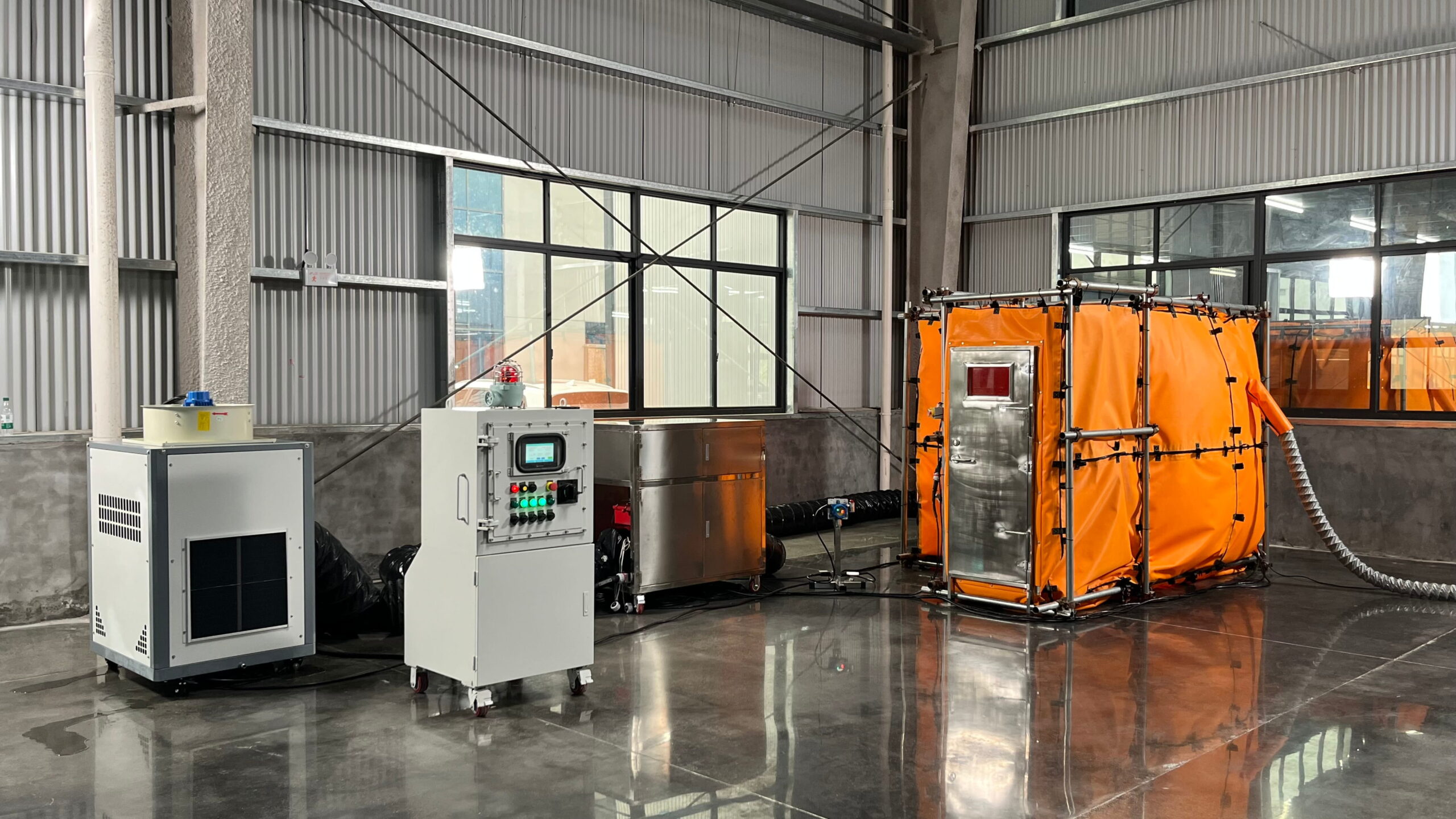
Hot work such as welding, cutting and grinding is common during construction, maintenance and repair operations in the oil and gas industry. However, performing these activities in offshore platforms, FPSO vessels, refineries and petrochemical facilities can require additional engineering controls because sparks, hot particles and ignition sources may be generated close to sensitive operating areas.
A pressurized welding habitat system, also known as a positive pressure welding habitat or hot work habitat, creates a temporary enclosed workspace around the hot work area. Depending on the project design, the system can combine fire-resistant enclosure panels, controlled ventilation, positive pressure, gas monitoring, differential pressure monitoring, alarms and other safety functions.
For procurement teams, however, selecting a welding habitat is not simply a matter of choosing the enclosure dimensions.
This guide explains the main components, technical parameters and procurement questions buyers should evaluate when sourcing a pressurized welding habitat system for oil and gas projects.
What Is a Pressurized Welding Habitat System?
A pressurized welding habitat is a temporary or modular enclosure designed to provide a controlled workspace for welding and other hot work activities.
A complete system may include:
- Fire-resistant welding habitat panels
- Structural support frame
- Access door
- Fresh-air supply or ventilation equipment
- Air ducts
- Differential pressure monitoring
- Gas detection and monitoring
- Temperature monitoring
- PLC or control system
- Audible and/or visual alarms
- Emergency stop
- Internal lighting
- Electrical and connection components
Fresh air is supplied to the enclosure according to the system design, while pressure conditions are monitored to help maintain the required working environment.
The exact configuration should always be determined according to the project specification, installation location, hazardous-area requirements and applicable site procedures.
Where Are Welding Habitat Systems Used?
Pressurized welding habitats are primarily used where hot work needs to be isolated or controlled within an industrial operating environment.
Typical applications include:
Offshore Platforms
Maintenance, structural modification, pipe repair and equipment installation may require welding or cutting while other parts of the facility remain operational.
A portable or modular offshore welding habitat can provide a dedicated enclosure around the work area.
FPSO Vessels
FPSO projects can present additional considerations such as limited deck space, marine corrosion, equipment positioning, ventilation routing and installation constraints.
For this reason, an FPSO welding habitat system may require customized dimensions, support structures and ventilation arrangements.
Oil & Gas Facilities
Welding habitats can also be considered for maintenance and modification activities in oil and gas processing facilities where project-specific hot work controls are required.
Refineries and Petrochemical Plants
Temporary welding enclosures may be used during shutdowns, maintenance and equipment modification projects.
Shipyards and Marine Engineering
Portable welding habitats can help separate welding, grinding and other hot work activities from surrounding work areas.
What Does a Complete Welding Habitat System Include?
One of the most important questions for buyers is whether a supplier provides only the enclosure or can support a complete system.
The following components should be evaluated during procurement.
1. Fire-Resistant Welding Habitat Panels
The enclosure panels form the physical boundary of the welding habitat.
Depending on the design, panels may use silicone-coated fiberglass fabric or other fire-resistant industrial materials.
Important specifications include:
- Base fabric
- Coating material
- Total fabric weight
- Thickness
- Temperature resistance
- Flame and fire performance
- Panel dimensions
- Joining method
- Reinforcement method
- Service life
- Relevant test reports or certifications
For modular systems, panel connection design is particularly important because the enclosure may need to be assembled and disassembled repeatedly.
Connections can include fire-resistant zippers, hook-and-loop fasteners and reinforced attachment points, depending on the project design.
2. Welding Habitat Support Structure
The frame provides structural support for the enclosure.
The appropriate frame material depends on the operating environment and project specification. Common considerations include:
- Indoor or outdoor installation
- Offshore or onshore environment
- Humidity
- Salt exposure
- Wind conditions
- Required structural stability
- Installation frequency
- Corrosion resistance
For offshore and FPSO projects, stainless-steel structures may be considered where enhanced corrosion resistance is required.
The final material selection should be based on the actual environmental conditions and the end user’s engineering requirements.
3. Positive Pressure and Ventilation System
The ventilation system is one of the key differences between a simple welding enclosure and a pressurized welding habitat system.
Fresh air is supplied into the enclosed workspace to support the required ventilation and pressure conditions.
When evaluating the ventilation system, buyers should confirm:
- Habitat internal volume
- Required airflow
- Required air changes
- Fan capacity
- Air duct diameter and length
- Fresh-air intake location
- Exhaust arrangement
- Pressure requirements
- Number of workers inside the habitat
- Heat generated by the hot work process
A larger fan is not automatically a better solution. The system should be engineered around the volume and operating requirements of the enclosure.
4. Differential Pressure Monitoring
A positive-pressure habitat normally requires pressure monitoring so operators can identify whether the enclosure is maintaining the specified pressure condition.
A differential pressure sensor can measure the pressure difference between the inside of the habitat and the surrounding environment.
Depending on the system design, pressure data may also be integrated into the PLC and alarm system.
Buyers should ask:
What happens if the pressure falls outside the specified operating range?
The answer should be defined by the project’s control philosophy and safety requirements rather than assumed.
5. Gas Detection and Monitoring
Gas monitoring can be an important part of welding habitat system design in oil and gas applications.
The required gases, sensor locations, alarm thresholds and system response should be determined according to the site specification and risk assessment.
Procurement teams should therefore confirm:
- Which gases need to be monitored?
- How many detection points are required?
- Where will the sensors be installed?
- Are local displays required?
- Does gas detection need to communicate with the PLC?
- What alarm outputs are required?
- Is shutdown or interlocking functionality specified?
These requirements should be established before the final system configuration is approved.
6. PLC and Control System
A PLC-based control system can integrate multiple monitoring and control functions into one interface.
Depending on the project requirements, the control system may manage or display information from:
- Ventilation equipment
- Differential pressure sensors
- Gas detectors
- Temperature sensors
- Alarm devices
- Emergency stop
- Lighting
- Other project-specific devices
For engineered projects, buyers should request a clear description of the system’s control logic and operating sequence.
7. Alarm and Emergency Functions
The required alarm philosophy varies between projects.
Possible functions can include:
- Audible alarm
- Visual alarm
- Pressure abnormal alarm
- Gas concentration alarm
- Temperature alarm
- Ventilation status indication
- Emergency stop
The exact response to an alarm condition should follow the approved project design and site safety procedures.
Positive Pressure Welding Habitat vs. Basic Welding Enclosure
These two products should not be treated as equivalent.
| Basic Welding Enclosure | Pressurized Welding Habitat System |
|---|---|
| Mainly provides physical separation | Provides an engineered controlled workspace |
| Fire-resistant curtain or panels | Fire-resistant enclosure panels |
| Basic ventilation may be used | Controlled ventilation/air supply |
| Pressure monitoring usually not included | Differential pressure monitoring can be integrated |
| Gas monitoring may not be included | Gas detection can be integrated |
| Limited control functions | PLC/control system can be incorporated |
| Suitable for simpler applications | Designed for more demanding industrial projects |
For oil and gas projects, procurement teams should evaluate the complete technical scope rather than comparing suppliers solely by enclosure dimensions or price.
How to Select the Correct Welding Habitat Size
Welding habitats can be manufactured in standard or customized dimensions.
Examples may include:
- 2 × 2 × 3 m
- 3 × 3 × 3 m
- 4 × 4 × 3 m
- Project-specific custom dimensions
However, size selection should not be based only on the physical dimensions of the welding location.
Buyers should consider:
Number of Operators
The habitat should provide sufficient working space for welders and supporting personnel.
Welding Equipment
Allow adequate space for welding machines, tools, cables and other required equipment.
Access and Escape Routes
Door position and access requirements should be considered during the layout stage.
Ventilation Requirements
Increasing the enclosure volume changes the ventilation requirement and may affect fan selection.
Site Restrictions
Offshore decks, pipe racks and industrial facilities may have structural obstacles that make a standard rectangular enclosure unsuitable.
For this reason, providing drawings or photographs of the installation area can significantly improve system design accuracy.
Welding Habitat Panel Materials: What Should Buyers Check?
Panel material deserves particular attention because it is exposed to welding sparks, heat and repeated installation.
A typical industrial solution may use silicone-coated fiberglass fabric.
When comparing welding habitat panels, buyers should not evaluate only the color or nominal thickness.
Instead, check:
Base Fabric → Coating → Fabric Weight → Thickness → Fire Performance → Temperature Resistance → Seam Construction → Connection System → Reinforcement → Test Documentation
For example, Huarui manufactures welding habitat panels using heavy-duty silicone-coated fiberglass structures for industrial hot work applications.
Panel configurations can be customized with fire-resistant zippers, fire-resistant hook-and-loop connections and reinforced attachment points according to project requirements.
Why FM 4950 Matters for Welding Habitat Panels
For projects where third-party certification is specified, buyers should carefully review exactly which product or component has been tested and what the certification covers.
FM 4950 is particularly relevant when evaluating materials used for welding curtains and welding habitat applications.
Huarui welding habitat panels are available with FM 4950 documentation for the applicable tested product.
Procurement teams should request the actual certificate or technical documentation when certification is a mandatory project requirement rather than relying only on a supplier’s marketing description.
Offshore and FPSO Projects: Additional Considerations
An offshore welding habitat system may face conditions that are different from those of a conventional indoor industrial enclosure.
Important factors can include:
Corrosion
Marine environments can increase corrosion risk for structural and mechanical components.
Frame material and surface treatment should therefore be evaluated according to the installation environment.
Wind and Weather
Outdoor installation may require additional consideration of structural stability and anchoring.
Limited Installation Space
FPSO and offshore facilities often contain pipes, equipment, platforms and structural obstructions.
Customized panel dimensions and openings may therefore be necessary.
Duct Arrangement
The location of the fresh-air supply and duct routing should be considered during layout design.
Electrical Requirements
Voltage, frequency, plugs, connectors and hazardous-area electrical requirements should be confirmed before production.
Transportation and Repeated Installation
For temporary maintenance projects, the system may need to be transported, assembled, dismantled and stored repeatedly.
Modular design can therefore be an important procurement consideration.
15 Specifications to Confirm Before Ordering a Welding Habitat System
Before requesting a final quotation, procurement teams should provide as much of the following information as possible:
- Application – welding, cutting, grinding or other hot work
- Installation location – offshore, FPSO, refinery, petrochemical plant, shipyard, etc.
- Required habitat dimensions
- Available installation space
- Panel material requirements
- Support frame material requirements
- Door size and position
- Ventilation requirements
- Required positive pressure parameters
- Gas detection requirements
- Temperature monitoring requirements
- PLC/control requirements
- Electrical voltage and frequency
- Certification/documentation requirements
- Project drawings, specifications and end-user requirements
For customized projects, technical drawings and site information should ideally be reviewed before the final quotation and production configuration are confirmed.
What Documents Should a Welding Habitat Supplier Provide?
Documentation requirements vary between projects, but buyers may request:
- Technical Data Sheet (TDS)
- Product specifications
- Material information
- Relevant test reports
- Certificates
- System configuration
- General arrangement drawing
- Panel layout drawing
- Electrical information
- Equipment list
- Compliance matrix
- Warranty information
- Installation or operating instructions
For EPC and oil & gas projects, document quality can be almost as important as the physical equipment because the proposed system may need to pass several rounds of technical review before procurement approval.
How to Evaluate a Welding Habitat System Supplier
Price should be only one part of the evaluation.
A capable welding habitat system manufacturer should be able to understand the technical requirements behind the RFQ and provide a configuration suitable for the project.
Before selecting a supplier, consider the following questions:
Can the supplier manufacture the fire-resistant panels?
Direct manufacturing can provide greater flexibility for customized dimensions, doors, ducts and connection arrangements.
Can the supplier provide a complete system?
Determine whether the quotation includes only panels or also ventilation, monitoring, controls and other required components.
Can the system be customized?
Oil and gas projects rarely have identical installation conditions.
Can the supplier provide drawings?
Layout drawings help the engineering team evaluate dimensions, doors, ducts and equipment positions before production.
Can the supplier respond to a technical compliance matrix?
For project procurement, the ability to review specifications item by item is important.
Are the certification claims supported by documentation?
Always verify the scope and applicability of certificates and test reports.
Does the supplier have relevant project experience?
Experience with offshore, oil and gas or industrial hot work projects can help identify practical design issues earlier in the procurement process.
Common Mistakes When Buying a Welding Habitat System
Comparing Only the Price
Two quotations may both say “welding habitat” while including completely different scopes.
Always compare the Bill of Materials (BOM), system configuration and technical specifications before comparing prices.
Confirming Only the Dimensions
A 3 × 3 × 3 m enclosure from two suppliers may differ substantially in panel construction, ventilation, controls, monitoring and accessories.
Ignoring the Installation Environment
A system intended for an indoor workshop and one intended for an offshore deck may require different materials and configurations.
Leaving Electrical Requirements Until the End
Voltage, frequency and electrical requirements should be established before production.
Assuming Every Certificate Covers the Complete System
Certification may apply to a specific material, panel or component rather than the complete assembled habitat system.
Buyers should verify the exact scope of each document.
Custom Pressurized Welding Habitat Systems
There is no single configuration suitable for every oil and gas project.
A welding habitat for an offshore platform may require a different structure, ventilation arrangement and monitoring configuration from a habitat used in a refinery or shipyard.
Huarui provides customized welding habitat panels and pressurized welding habitat systems for industrial hot work applications.
Depending on project requirements, available solutions can include:
- Customized habitat dimensions
- Fire-resistant silicone-coated fiberglass panels
- Modular panel connections
- Customized access doors
- Stainless-steel support structures
- Ventilation and air duct systems
- Differential pressure monitoring
- Gas monitoring
- Temperature monitoring
- PLC control
- Alarm and emergency-stop functions
- Lighting
- Layout drawings
- Technical documentation
- OEM and project-specific configurations
Request a Welding Habitat System Proposal
If you are sourcing a pressurized welding habitat system for an oil & gas, offshore, FPSO, refinery or petrochemical project, providing detailed project information at the RFQ stage can significantly improve quotation accuracy.
For an initial technical evaluation, send:
Application + Habitat Size + Installation Environment + Project Location + Electrical Requirements + Required System Functions + Certification Requirements + Drawings/Technical Specifications
Based on these details, our team can review the project requirements and prepare an appropriate welding habitat configuration, layout and commercial proposal.
Frequently Asked Questions
What is a pressurized welding habitat system?
It is a temporary or modular enclosed workspace designed for welding and other hot work operations. Depending on the project design, it can combine fire-resistant panels, controlled ventilation, positive pressure, gas detection, pressure monitoring and control functions.
What is the difference between a welding habitat and a welding enclosure?
A basic welding enclosure primarily provides physical separation around a work area. A pressurized welding habitat can incorporate ventilation, pressure control, monitoring, alarms and other engineered functions required by more demanding industrial applications.
Can welding habitats be customized?
Yes. Dimensions, doors, panel layouts, duct positions, support structures and system components can be configured according to project requirements.
Are welding habitats suitable for offshore and FPSO projects?
They can be designed for offshore and FPSO applications, but the final configuration should consider the marine environment, installation location, structural requirements, ventilation, electrical specifications and applicable project safety requirements.
What information is needed to quote a welding habitat system?
At minimum, buyers should provide the required dimensions, application, installation environment, electrical requirements and required system functions. Project specifications, drawings and end-user requirements are highly useful for engineered systems.
Can the welding habitat panels be supplied separately?
Yes. For projects where the customer already has the required ventilation, control or support equipment, fire-resistant welding habitat panels can also be supplied as a separate package.