

Welding in oil and gas facilities is already a high-risk activity. When extreme heat, high humidity, strong offshore winds and potentially flammable atmospheres are added to the working environment, controlling the welding area becomes even more important.
A properly designed welding habitat system creates a temporary, controlled enclosure around a welding operation. It can help contain sparks, reduce the influence of wind and weather, support gas monitoring, improve ventilation and provide a more stable environment for both welders and welding processes.
For offshore platforms, refineries, petrochemical plants, pipelines and other energy infrastructure, a welding habitat is therefore much more than a simple welding tent. It is part of a broader hot-work safety and environmental-control system.
What Is a Welding Habitat System?
A welding habitat system is a temporary enclosure installed around a welding, cutting, grinding or other hot-work area.
Depending on the project and hazardous-area requirements, the system may include:
- Flame-resistant enclosure panels
- Modular frames and access doors
- Controlled air supply
- Mechanical ventilation
- Welding fume extraction
- Gas detection and alarm equipment
- Pressure or airflow monitoring
- Emergency shutdown interfaces
- Temperature and humidity monitoring
- Suitable lighting and electrical accessories
The exact configuration must be determined by the site classification, hot-work risk assessment, welding process and operator requirements.
Unlike a basic weather shelter, an engineered welding habitat is designed to manage several hazards at the same time.
Why Extreme Heat Makes Welding More Difficult
High ambient temperatures place additional pressure on welders, equipment and the temporary enclosure itself.
Welders are exposed not only to outdoor heat but also to radiant heat from the welding arc, hot metal surfaces and nearby process equipment. At the same time, welding clothing, gloves, helmets and other personal protective equipment can restrict heat loss from the body.
The US National Institute for Occupational Safety and Health describes occupational heat stress as the combined effect of environmental heat, metabolic heat and the clothing or PPE worn by a worker. Excessive heat exposure can increase the risk of heat-related illness and physical injury.
For this reason, simply enclosing the welding area with fire-resistant fabric is not enough. Without suitable airflow, ventilation or cooling, the enclosure may trap heat and welding fumes.
An effective welding habitat for hot climates should be designed to control the internal environment rather than merely isolate it from the surroundings.
Controlling Hot Work Near Oil and Gas Operations
Oil and gas facilities may contain flammable gases, vapours, liquids or residues. Welding arcs, sparks, molten metal and heated surfaces can all act as ignition sources.
The UK Health and Safety Executive identifies welding and similar hot processes as potential ignition sources. It also notes that hot work, vessel entry and cutting into pipework containing hazardous materials are examples of high-risk activities that may require a formal permit-to-work procedure.
A welding habitat can support hot-work controls by helping to:
- Contain sparks and molten particles
- Separate the immediate welding area from surrounding operations
- Establish defined access points
- Support continuous atmospheric monitoring
- Control airflow into and out of the work zone
- Provide a location for alarms and emergency shutdown equipment
- Reduce interference from nearby activities
However, a welding habitat does not make hot work automatically safe.
It must be used as part of a complete control system that may include equipment isolation, line cleaning, gas testing, hot-work permits, fire watches, emergency planning and continuous supervision.
Protecting Weld Quality from Offshore Wind
Strong and unpredictable wind is one of the major challenges of offshore and outdoor welding.
Processes such as MIG, MAG, TIG and gas-shielded flux-cored arc welding depend on a stable shielding-gas envelope around the arc and molten weld pool. Wind can disturb or displace this gas, allowing the weld area to be exposed to the surrounding atmosphere.
TWI notes that wind and rain can affect gas-shielded MIG welding. It also identifies wind, moisture and loss of shielding gas as factors that can contribute to welding problems such as increased spatter.
By creating a protected work zone, a welding habitat can help:
- Reduce direct wind at the welding point
- Stabilise shielding-gas coverage
- Prevent rain from reaching prepared joints
- Reduce contamination from salt spray
- Maintain more consistent welding conditions
- Support repeatable welding parameters
- Lower the risk of avoidable weld defects and rework
This is especially valuable when welding offshore process piping, pressure systems, pipeline joints, structural components and corrosion-resistant alloys.
Managing Humidity, Rain and Salt-Laden Air
Offshore environments combine high humidity with salt spray, condensation and rapid weather changes.
Moisture may contaminate prepared welding surfaces, consumables or equipment. Salt deposits can also affect surface cleanliness and contribute to corrosion if they are not properly controlled.
A welding habitat provides a physical barrier between the weld zone and the external marine environment. When combined with appropriate environmental monitoring and air-management equipment, it can create more stable conditions for joint preparation, preheating, welding and inspection.
The habitat may also help prevent sudden rain showers from interrupting critical welding operations.
Environmental protection is particularly important where the welding procedure specifies limits for surface moisture, ambient conditions, interpass temperature or consumable handling.
Ventilation Is Critical Inside a Welding Habitat
Although a welding habitat protects the work area from wind and weather, it also creates a partially or fully enclosed space. Without adequate ventilation, welding fumes, gases and heat can accumulate.
The US Occupational Safety and Health Administration requires mechanical or local exhaust ventilation for certain welding operations in enclosed spaces. OSHA also advises against welding in confined spaces without ventilation.
The UK Health and Safety Executive recommends controlling welding fumes by capturing them at source where possible. Source extraction protects the welder and limits the spread of fumes into the surrounding work area.
A suitable welding habitat ventilation system may therefore include:
General Mechanical Ventilation
General ventilation supplies fresh air and removes heat and contaminated air from the enclosure.
The airflow must be carefully designed. Excessive air movement near the welding arc may disturb the shielding gas, while insufficient airflow may allow heat and fumes to accumulate.
Local Exhaust Ventilation
Local exhaust ventilation captures fumes close to the point where they are generated.
Extraction equipment should be positioned so that it removes fumes without pulling shielding gas away from the weld pool.
Temperature Monitoring
Temperature monitoring helps supervisors identify when the internal habitat environment is becoming unsuitable for workers or welding equipment.
Depending on the project, temperature control may be supported by air-conditioning or cooling equipment suitable for the relevant operating area.
Gas and Oxygen Monitoring
The required monitoring arrangement depends on the site hazards.
It may include checks for combustible gases, oxygen concentration or specific toxic gases. Sensors must be selected, positioned and maintained according to the substances that may be present and the project’s risk assessment.
Important Components of a Hot-Climate Welding Habitat
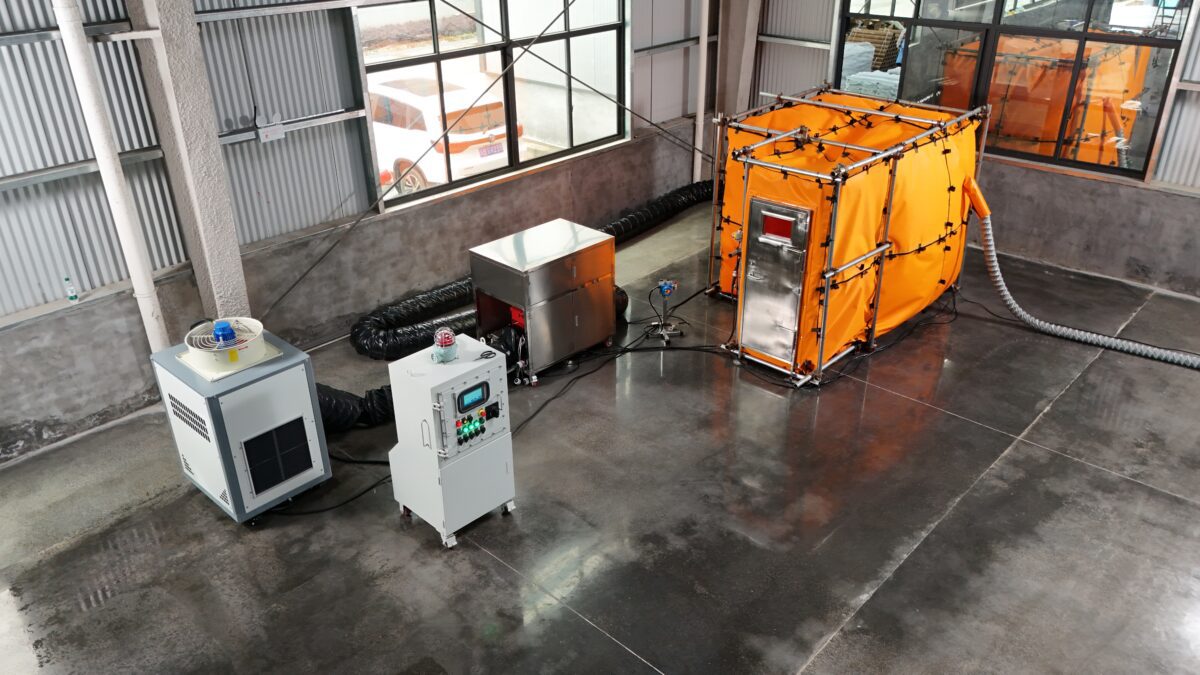
A welding habitat intended for oil, gas or offshore work in high temperatures should be treated as an integrated system.
Key components may include the following.
Flame-Resistant Enclosure Materials
The enclosure should resist ignition and help contain sparks, spatter and radiant heat.
Material selection should consider temperature resistance, mechanical strength, seam construction, visibility requirements and compatibility with the operating environment.
Modular Support Structure
A modular frame allows the habitat to be adapted around pipes, valves, structural members and irregular work areas.
The structure should remain stable under the expected site conditions and should not obstruct emergency escape routes.
Controlled Ventilation
The system should provide enough airflow to manage heat and fumes without negatively affecting the welding process.
Air inlets, outlets and extraction points should be positioned based on the enclosure geometry and hot-work location.
Gas Detection and Alarm Systems
Where flammable or hazardous gases may be present, continuous monitoring may form part of the project’s hot-work controls.
Alarm levels, shutdown actions and responsibilities should be established before welding begins.
Suitable Electrical Equipment
Lighting, fans, monitoring equipment, cables and accessories must be selected according to the applicable hazardous-area classification and site requirements.
Standard electrical products should not automatically be assumed suitable for offshore oil and gas applications.
Emergency Access and Escape
Personnel must be able to enter and leave the habitat safely.
Access doors, escape routes and emergency procedures should remain clear throughout the operation.
How a Welding Habitat Supports Productivity
The primary purpose of a welding habitat is risk control, but a properly designed system can also improve operational efficiency.
More stable welding conditions may reduce weather-related delays and repeated setup work. Protecting the weld from wind and rain can also help maintain process consistency.
Potential operational benefits include:
- Fewer interruptions caused by changing weather
- Better control of joint preparation conditions
- More consistent shielding-gas performance
- Reduced contamination of welding surfaces
- Lower risk of weather-related weld repairs
- Improved coordination between welding and inspection teams
- More predictable hot-work scheduling
These benefits are particularly valuable offshore, where downtime, labour, vessel support and equipment mobilisation can be expensive.
A poorly designed habitat, however, can create new problems. Excessive internal heat, inadequate fume extraction or incorrect airflow may reduce productivity and increase risk.
The system must therefore be engineered around the real working conditions.
Where Welding Habitat Systems Are Commonly Used
Welding habitats may be used for maintenance, repair, modification and construction work in locations such as:
- Offshore oil and gas platforms
- Floating production, storage and offloading vessels
- Refineries and petrochemical plants
- LNG and gas-processing facilities
- Onshore and offshore pipelines
- Compressor and pumping stations
- Storage terminals
- Shipyards and marine engineering sites
- Power-generation facilities
- Chemical-processing plants
They may support welding, cutting, grinding, brazing and other activities classified as hot work by the site operator.
How to Select a Welding Habitat System
Selecting a welding habitat should begin with the project hazards rather than the enclosure dimensions alone.
Before choosing a system, project teams should consider:
- The hazardous-area classification
- The possible gases or vapours present
- The required welding process
- Ambient temperature and humidity
- Wind speed and weather exposure
- Available space around the work area
- Ventilation and extraction requirements
- Power and air-supply limitations
- Emergency access requirements
- Site-specific permit-to-work procedures
The enclosure material is only one part of the solution.
Fans, ducts, gas detectors, alarms, electrical equipment, access systems and operating procedures must work together as a complete system.
A Welding Habitat Does Not Replace Risk Assessment
It is important to avoid describing a welding habitat as an independent guarantee of explosion protection or hot-work safety.
The habitat is an engineering control that supports a wider safety programme. Its effectiveness depends on correct design, installation, inspection, operation and supervision.
Every project should follow the applicable regulations, client specifications, welding procedures and health, safety and environmental requirements.
Before work begins, competent personnel should confirm that:
- The equipment and process have been isolated where required
- The work area has been inspected
- Atmospheric testing has been completed
- Ventilation is operating correctly
- Gas detectors are functional
- Emergency actions are understood
- Fire-control equipment is available
- The hot-work permit has been approved
- Workers understand heat-stress precautions
- Conditions remain acceptable throughout the job
Conclusion
Extreme heat makes an already demanding welding environment more difficult.
For oil and gas facilities, offshore platforms and pipeline projects, welders may face several hazards at once: high ambient temperatures, radiant heat, strong wind, humidity, salt spray, welding fumes and the possible presence of flammable substances.
A properly engineered welding habitat system helps create a defined and controlled hot-work area. It can contain sparks, protect the weld from weather, support ventilation and gas monitoring, improve welding consistency and reduce heat-related operational challenges.
The most effective system is not simply a fire-resistant tent.
It is an integrated solution combining flame-resistant enclosure materials, environmental control, fume extraction, gas detection, suitable electrical equipment and disciplined hot-work procedures.
For projects operating in extreme heat or harsh offshore conditions, selecting the right welding habitat system can make a significant difference to worker protection, weld quality and operational continuity.